Wind erosion and sand movement are critical challenges in arid and semi-arid regions, affecting agriculture, transportation infrastructure, and long-term land stability. Strong winds accelerate soil loss, damage vegetation, and transport sand and dust across large areas, often resulting in buried roads, disrupted railways, and declining land productivity.
To address these challenges, windbreak net systems—commonly referred to as sand barriers in large-scale projects—have become an essential solution. Rather than completely blocking airflow, modern HDPE windbreak netting reduces wind speed in a controlled way, effectively limiting sand movement and dust dispersion while maintaining environmental balance.
Part 1: What Is a Windbreak Net?
A windbreak net is a permeable mesh structure designed to reduce wind velocity and control airborne sand and dust. Unlike solid walls or rigid fences, windbreak nets work by allowing a calculated amount of air to pass through, which minimizes turbulence and prevents wind from regaining strength immediately behind the barrier.
In professional applications, windbreak nets are manufactured from HDPE (High-Density Polyethylene) and treated with UV stabilizers for long-term outdoor use. Depending on mesh density and installation height, these systems can reduce wind speed by 30% to more than 70%. This makes them suitable for both large-scale sand control projects and smaller applications such as windbreaks for gardens or plantations in dry regions.

Part 2:How Does a Windbreak Net Work Against Wind and Dust?
The effectiveness of a windbreak net lies in its aerodynamic design. Wind carries energy, and that energy is what allows sand and dust particles to lift from the ground and travel long distances. By disrupting wind flow gradually, windbreak nets reduce that energy before it can cause damage.
1. Controlled Wind Deceleration
When wind passes through HDPE windbreak netting, its speed is reduced rather than abruptly stopped. This controlled deceleration prevents the formation of strong eddies and turbulence, which are common behind solid barriers. As a result, the protected area extends further downwind and remains more stable.
2. Sand and Dust Suppression
Sand and dust particles require a minimum wind speed to become airborne. Once wind velocity drops below this threshold, particles settle instead of drifting. This is why HDPE Windbreak Netting Against Wind and Dust is widely used in desert regions, along highways, and near railways where sand accumulation is a constant concern.
3. Microclimate Improvement
In agricultural and garden environments, reduced wind improves moisture retention and lowers plant stress. Although not designed as insect netting, windbreak nets can also block some larger insects, offering limited additional protection when used as a windbreak for garden or orchard perimeter.
Part 3:Why HDPE Is the Most Reliable Windbreak Material?
Choosing the correct windbreak material is essential for performance and longevity. HDPE has become the preferred option worldwide due to its mechanical strength and environmental resistance.
HDPE fibers provide excellent tensile strength while remaining lightweight, allowing large windbreak installations without excessive structural load. Unlike traditional plastics, HDPE does not absorb moisture, rot, or crack easily under temperature fluctuations.
UV stabilization is another critical factor. In desert and open-field environments, prolonged sun exposure can quickly degrade inferior materials. High-quality HDPE windbreak netting maintains flexibility and strength for many years, making it suitable for heavy duty windbreak netting applications where replacement is costly or impractical.
Part 4:Where and How Are Windbreak Netting Used?
Windbreak nets and sand barriers are used across a wide range of environments, from extreme deserts to cultivated land and infrastructure corridors. Their adaptability makes them one of the most effective long-term wind control solutions available.
1. Desert Areas and Sand Control Projects
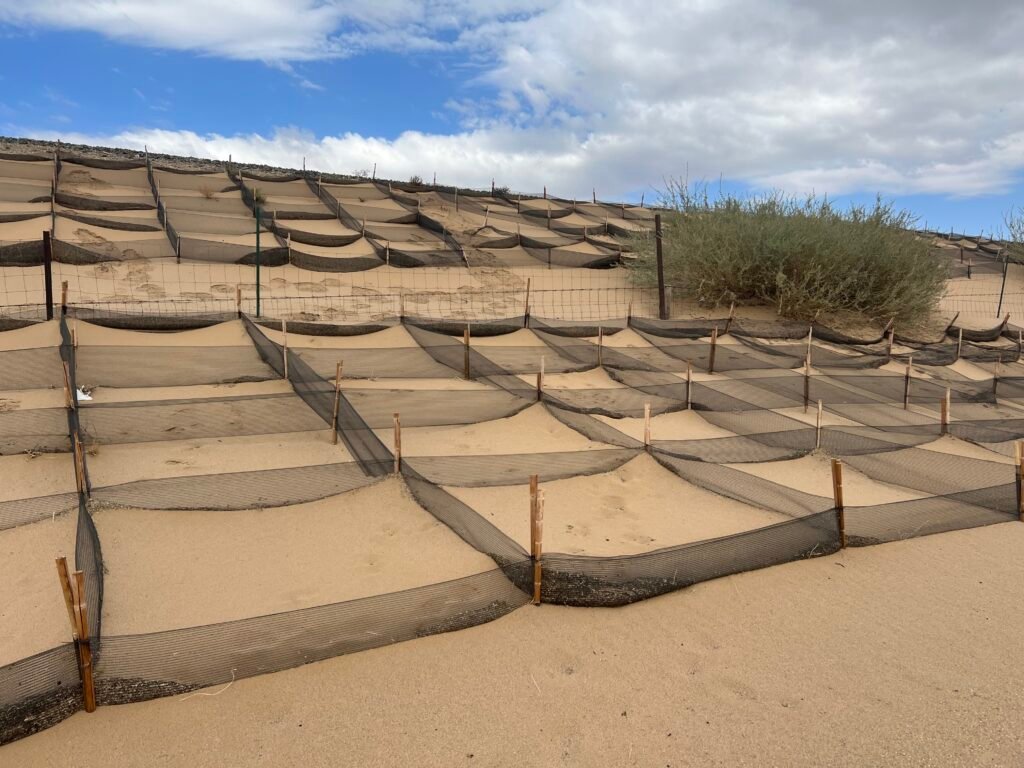
In desert regions, sand barriers are installed in linear or grid configurations to stabilize shifting dunes. By reducing wind velocity at ground level, these systems prevent sand from migrating into protected areas. Windbreak nets are widely used in land restoration and desert edge protection projects where traditional hard structures would be too expensive or environmentally disruptive.
2. Railways, Highways, and Infrastructure Zones
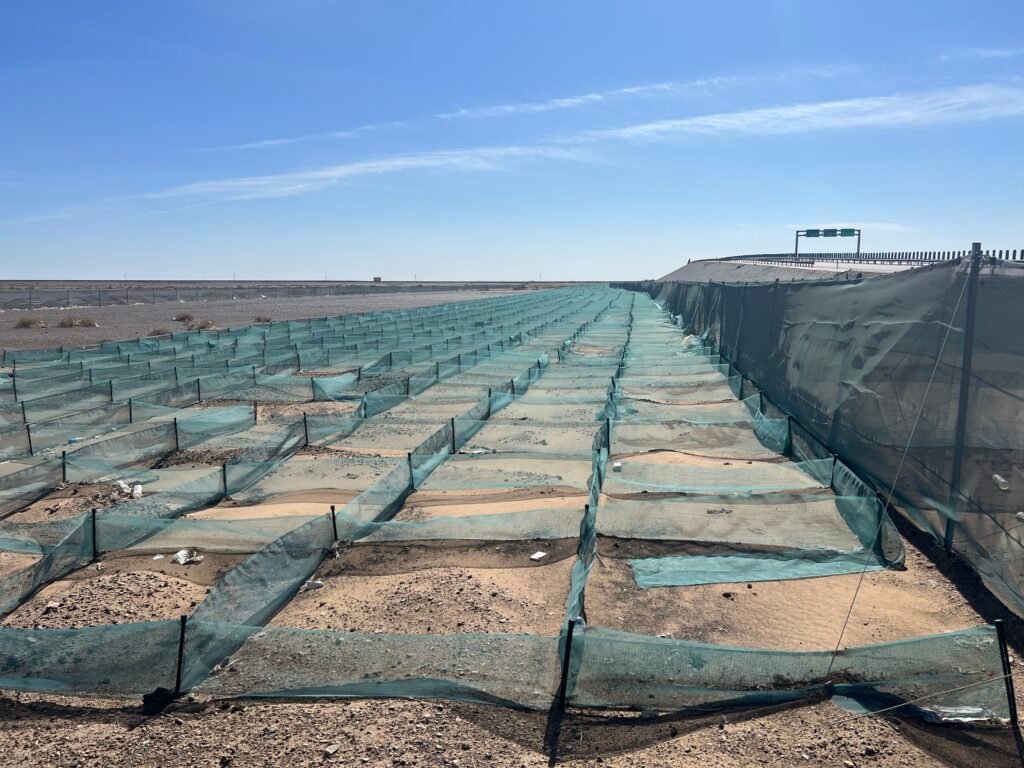
Transportation infrastructure is particularly vulnerable to windblown sand. Railways and highways in arid regions often rely on HDPE windbreak netting fencing to reduce sand accumulation and maintain safe operation. Compared to solid barriers, windbreak nets are easier to install along uneven terrain and require less maintenance over time.
3. Arid Farmland, Gardens, and Plantations
In dry agricultural areas, windbreak nets are increasingly used to protect crops from mechanical damage and dehydration. Installed around fields or growing zones, they function as an effective windbreak for garden and plantation use. Reduced wind exposure leads to healthier plants, improved soil moisture retention, and more stable yields.
4. Perimeter Windbreak Fencing Systems
Many windbreak fence ideas focus on creating perimeter protection rather than internal partitions. HDPE windbreak fencing is commonly used around industrial yards, nurseries, and agricultural land to establish controlled environments while maintaining airflow and visibility.
Part 5:How to Choose Heavy Duty Windbreak Netting for Long-Term Use
Selecting the right windbreak net involves more than choosing a mesh fabric. Environmental conditions, structural design, and expected service life all play a role.
Mesh density must match local wind conditions. High-wind zones require denser netting to achieve sufficient wind reduction, while moderate environments benefit from more open meshes that maintain airflow. Installation design is equally important—post spacing, net height, and anchoring systems must be engineered to withstand continuous wind loads.
Long-term performance depends heavily on material consistency and UV stabilization. Poor-quality netting may look similar at first but can fail prematurely, leading to increased maintenance costs and reduced protection.
Part 6:What Is the Most Suitable Windbreak Netting Supplier and Manufacturer?
A reliable windbreak net manufacturer must demonstrate large-scale production capacity, consistent material quality, and experience in harsh outdoor conditions. Suppliers involved in desert sand control and infrastructure protection projects understand real-world stress factors such as sustained wind loads, UV exposure, and abrasive sand.
About Young Shade Sail:
Young Shade Sail a specialized manufacturer and supplier of HDPE windbreak nets, serving projects in desert sand control, railways, highways, and arid-region agriculture. With years of industry experience, we focus on providing engineering-grade solutions that perform reliably under extreme environmental conditions. Our production uses engineering-grade HDPE raw materials with strict quality control to ensure uniform mesh structure, stable tensile strength, and reliable UV resistance.
Our Expertise and Capabilities:
- Professional Manufacturing: Large-scale production with strict quality control ensures uniform mesh structure, stable tensile strength, and high durability.
- Engineering-Grade Materials: We use premium HDPE raw materials, offering excellent UV resistance, long service life, and consistent performance even in harsh conditions.
- Specialized Applications: Our products are designed specifically for desert sand prevention, infrastructure protection, and large agricultural projects.
- Custom Manufacturing Capability: We operate a self-owned factory equipped with the world’s largest and most advanced CNC machines, making it the largest wire mesh production facility globally. Our fully automated production lines allow us to customize windbreak nets in any size and quantity, meeting the demands of large-scale projects with precision and efficiency.
- Proven Track Record: Supplying globally, we have supported numerous large-scale projects, demonstrating our ability to deliver durable, high-performance solutions every time. We welcome agents, distributors, and large-scale projects from around the world to cooperate with us. We will provide high-quality, stable, and long-term technical support.
By combining technical expertise, high-quality materials, and extensive experience, we provide windbreak nets and sand barriers that meet the demanding needs of modern environmental and infrastructure projects.
Conclusion
Wind erosion and sand movement present ongoing challenges for infrastructure, agriculture, and land management. From large-scale desert sand barriers to agricultural and garden windbreak systems, windbreak net solutions offer a proven, sustainable way to reduce wind speed, control dust, and stabilize vulnerable environments.
By selecting high-quality HDPE windbreak netting and working with an experienced manufacturer, long-term protection becomes achievable even in the harshest conditions. As climate pressures increase, well-designed windbreak systems will continue to play a vital role in protecting land, infrastructure, and productivity worldwide.