In desert regions and plainlands, the relentless force of wind-driven sand poses a serious threat to roads, railways, and infrastructure. Fine sand can drift onto roadways overnight, reducing visibility, eroding pavement, and endangering travelers. Traditional solutions—like rigid walls or vegetation belts—often fail in harsh conditions, or are cost-prohibitive. The more versatile and effective solution? Sand barriers, specifically HDPE-based mesh systems that can reduce wind velocity, trap particles, and stabilize surfaces—all while being flexible, quick to install, and durable.
Part 1 : Why Sand Drift Needs Smart Sand Barriers and Windbreak Solutions?
Wind-sand movement is primarily governed by near-surface aerodynamics. High-velocity winds lift and transport loose sand particles through saltation and surface creep, leading to dune migration, dust storms, and hazardous sand accumulation along transportation corridors. Solid barriers often create strong turbulence and airflow rebound, which can redistribute sand into adjacent areas instead of controlling it effectively. In contrast, porous HDPE windbreak net barriers reduce wind momentum while maintaining controlled airflow permeability, creating low-velocity deposition zones where airborne particles settle before reaching roads or infrastructure.
Numerous studies confirm this effect:
- CFD and wind-tunnel simulations of HDPE board sand fences show that wind speed drops sharply behind barriers, creating low-velocity zones where sand settles.
- Field observations on desert highways show that double-row vertical barriers reduce wind speed by up to 90% in some zones .
- Optimal height (~2.5 m) and spacing configurations maximize efficiency, balancing protection and material use.
Why Traditional Sand Control Methods Often Struggle in Desert Environments?
Alternative sand-control approaches, such as afforestation (planting trees), straw checkerboards, or soil-binding agents, have been widely tested. While they can be effective, they come with significant limitations:
- High Cost & Long Timelines – Establishing shelterbelts or ecological vegetation requires years of irrigation, maintenance, and protection before becoming effective.
- Uncertain Survival Rates – Harsh desert climates lead to low sapling survival, making results unpredictable and maintenance intensive.
- Limited Flexibility – Biological methods are fixed once established, and adapting to shifting sand or infrastructure projects can be impractical.
In contrast, engineered sand barriers offer rapid deployment, immediate results, modular adaptability, and far lower lifecycle costs. This makes them a smart, scalable solution where environmental and economic factors demand efficiency.
Part 2 : Practical Applications of HDPE Windbreak Net Sand Barriers in Desert Infrastructure
- Highways in desert regions: Reduces drifting sand accumulation, preserves roadway visibility, and minimizes maintenance interruptions caused by wind-blown sediment.
- Rail corridors: Prevents sand buildup along railway tracks, reduces operational risks, and helps maintain transportation efficiency in desert environments.
- Construction zones and unpaved roads: Shields work areas from airborne dust, loose sand intrusion, and surface erosion caused by strong winds.
- Communication base stations and critical infrastructure: Protects telecom facilities, power systems, and remote infrastructure from wind-blown sand accumulation, airborne dust intrusion, and long-term wind erosion damage.
Their flexibility allows quick deployment across long stretches, coupled with minimal foundation requirements—especially beneficial in remote or sandy terrains.
Part 3 : Environmental and Infrastructure Benefits of Sand Barrier Systems
Beyond their immediate role in stabilizing sand and reducing erosion, sand barriers contribute significantly to broader environmental and societal goals. By preventing sand movement, they protect fertile soil from desertification, helping preserve agricultural land and secure local food production. This role is especially critical in arid and semi-arid regions where farming is already under pressure.
Sand barriers also safeguard critical infrastructure—such as roads, railways, and residential areas—by minimizing sand accumulation and preventing costly disruptions. Effective infrastructure protection solutions can help reduce the impact of harsh environmental conditions, including wind-driven sand and desertification risks. For example, protective measures for exposed facilities such as base station towers play an important role in maintaining long-term operational stability. Overtime, these solutions not only reduce maintenance expenses but also support safer transportation networks and stronger local economies.
On a larger scale, widespread sand barrier implementation contributes to ecological restoration. Stabilized sand surfaces allow for vegetation growth, which in turn enhances biodiversity, improves carbon sequestration, and restores natural habitats for wildlife. These ecological gains position sand barriers as not just a protective measure, but also a sustainable investment in environmental resilience and community well-being.
Part 4 :How to Select Effective HDPE Windbreak Net Sand Barriers System?
1. Material & Structure
- HDPE mesh is favored for its tensile strength, UV stability, flexibility, and light weight.
- Structure should allow ~40–60% porosity, enabling wind to pass but lowering its speed to drop sand (proven optimal range)
2. Height & Spacing Configuration
- Research consistently shows ~2.5 m height offers strong wind-blocking while preventing aerosol rebound .
- Proper spacing (e.g., ≈ 1–2 H apart) creates overlapping low-velocity zones for sustained sedimentation
3. Installation Design
- Mesh tension must be adequate to resist deformation. Integrated selvage and reinforcement help maintain structure under high wind loads.
- Supports—like steel posts or buried anchors—should tolerate shifting soils.
4. Longevity & UV Protection
- HDPE with carbon black or UV stabilizers can survive years in full sun without structural degradation
5. Maintenance & Repairability
- Modular panels let workers replace damaged sections easily.
- Mesh, being light, can be lifted for seasonal maintenance without heavy machinery.
Part 5 :Why Young Shade Sail HDPE Windbreak Net Sand Barriers Perform in Harsh Desert Conditions?
Young Shade Sail offers sand barrier solutions that combine durability, efficiency, and long-term value, designed to withstand the toughest desert and coastal conditions. Unlike traditional barriers that quickly degrade under sun, wind, and shifting terrain, our systems deliver reliable, cost-effective performance for years.
1. Our System’s Advantages:
- HDPE Mesh with UV-Stabilized Additives – Made from premium HDPE and enhanced with UV stabilizers, our barriers resist cracking, brittleness, and fading. Even in regions with intense solar radiation and temperature fluctuations, the material maintains its strength and protective function.
- Optimized Porosity and Mesh Design – Our unique mesh structure is engineered to reduce wind speed while trapping up to 90% of airborne sand. This controlled airflow prevents dune migration, protects infrastructure, and creates safer, more stable environments for both communities and industries.
- Modular Panel Format – Built with UV-resistant HDPE, our sand barriers provide long-lasting protection with minimal maintenance. Fewer replacements mean lower life-cycle costs and better sustainability compared to conventional options.
- High Service Life (Up to 15 Years) – Our materials are non-toxic, recyclable, and eco-friendly, ensuring minimal ecological impact. They create controlled sand accumulation without harming vegetation or soil, supporting sustainable land management.
2. Why Partner with Young Shade Sail?
- Over a Decade of Expertise: With more than 10 years of manufacturing experience in shade and environmental protection systems, Young Shade Sail supplies UV-stabilized HDPE windbreak netting designed for long-term performance in desert, coastal, and high-wind environments.
- Global Track Record: Our solutions have been successfully deployed in 20+ countries across Asia, the Middle East, Africa, and beyond. From coastal erosion control projects to desert sand stabilization and infrastructure protection, our products have proven their effectiveness under diverse climatic and geographic conditions.
- Commitment to Sustainability: Every solution we design is built around eco-friendly materials, recyclable components, and reduced life-cycle costs, aligning with global standards for safety and environmental stewardship.
3. Global Desert Infrastructure Protection Experience
Young Shade Sail HDPE windbreak net sand barriers have been deployed across transportation corridors, railway systems, industrial facilities, and infrastructure protection projects in multiple desert and high-wind regions worldwide. Our systems are designed to withstand long-term UV exposure, shifting terrain, and severe sand erosion conditions commonly found in arid environments.
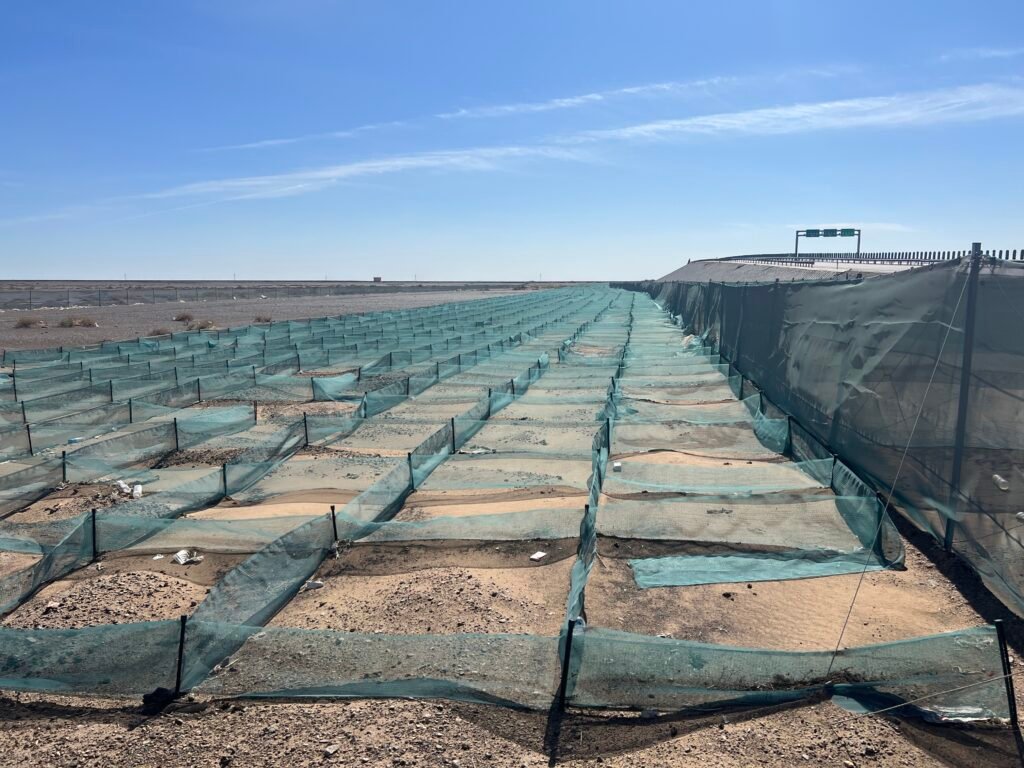
Desert Highway Protection in Northwestern China
Our HDPE windbreak net sand barriers have been installed along desert highways in Northwestern China to reduce drifting sand accumulation, improve road visibility, and minimize long-term roadway maintenance in high-wind desert environments.
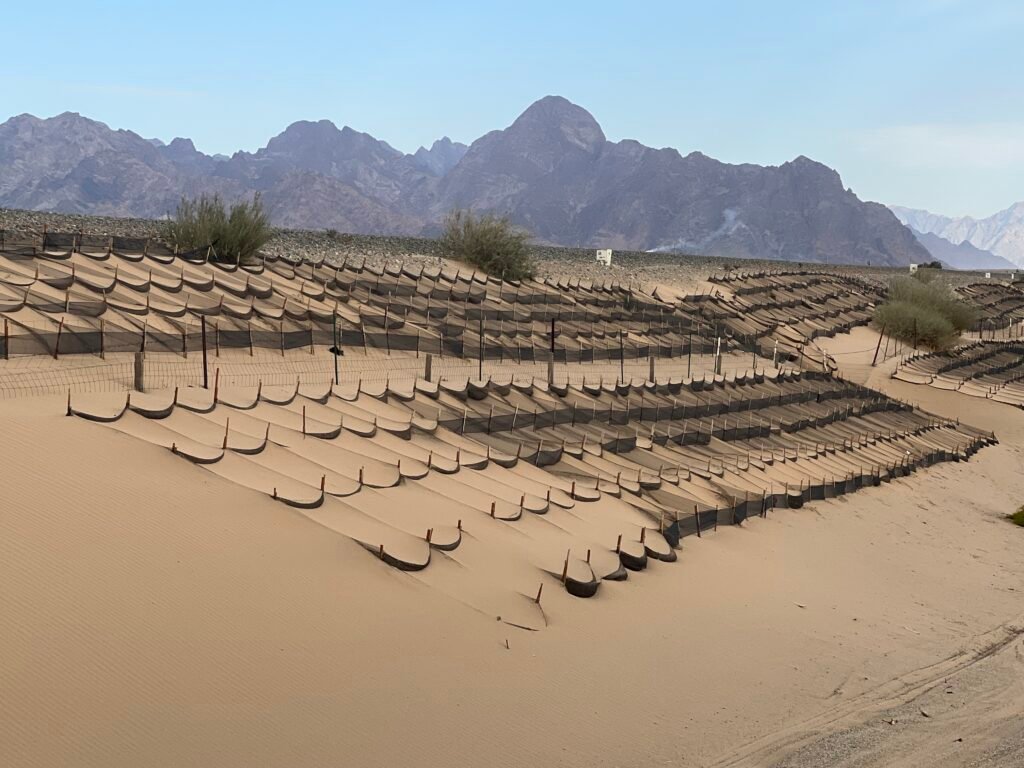
Railway Sand Control Projects in Inner Mongoli
Young Shade Sail sand barrier systems have been used for railway protection projects in Inner Mongolia, where porous windbreak net structures help reduce wind-driven sand intrusion along rail corridors and maintenance zones.
HUAWEI Saudi Arabia Communication Base Station Protection
In Saudi Arabia, our HDPE windbreak netting systems have been supplied for desert-area communication base station protection projects, helping reduce wind erosion and airborne sand exposure around critical infrastructure facilities.
Conclusion
The long-term effectiveness of a sand barrier system depends on aerodynamic design, controlled porosity, UV-resistant materials, and correct installation configuration. For highways, railways, airports, and industrial infrastructure exposed to drifting sand, HDPE windbreak net barriers provide a scalable and cost-efficient solution for reducing wind erosion, stabilizing terrain, and minimizing maintenance risks.
When constructing highways, railways, or perimeters in sandy terrains—or seeking to reduce maintenance costs and extend infrastructure life—Young Shade Sail’s sand barrier systems offer a combination of engineering excellence and field reliability.